
Tracer gas leak detection
Gas finds the leak where everything else gives up.
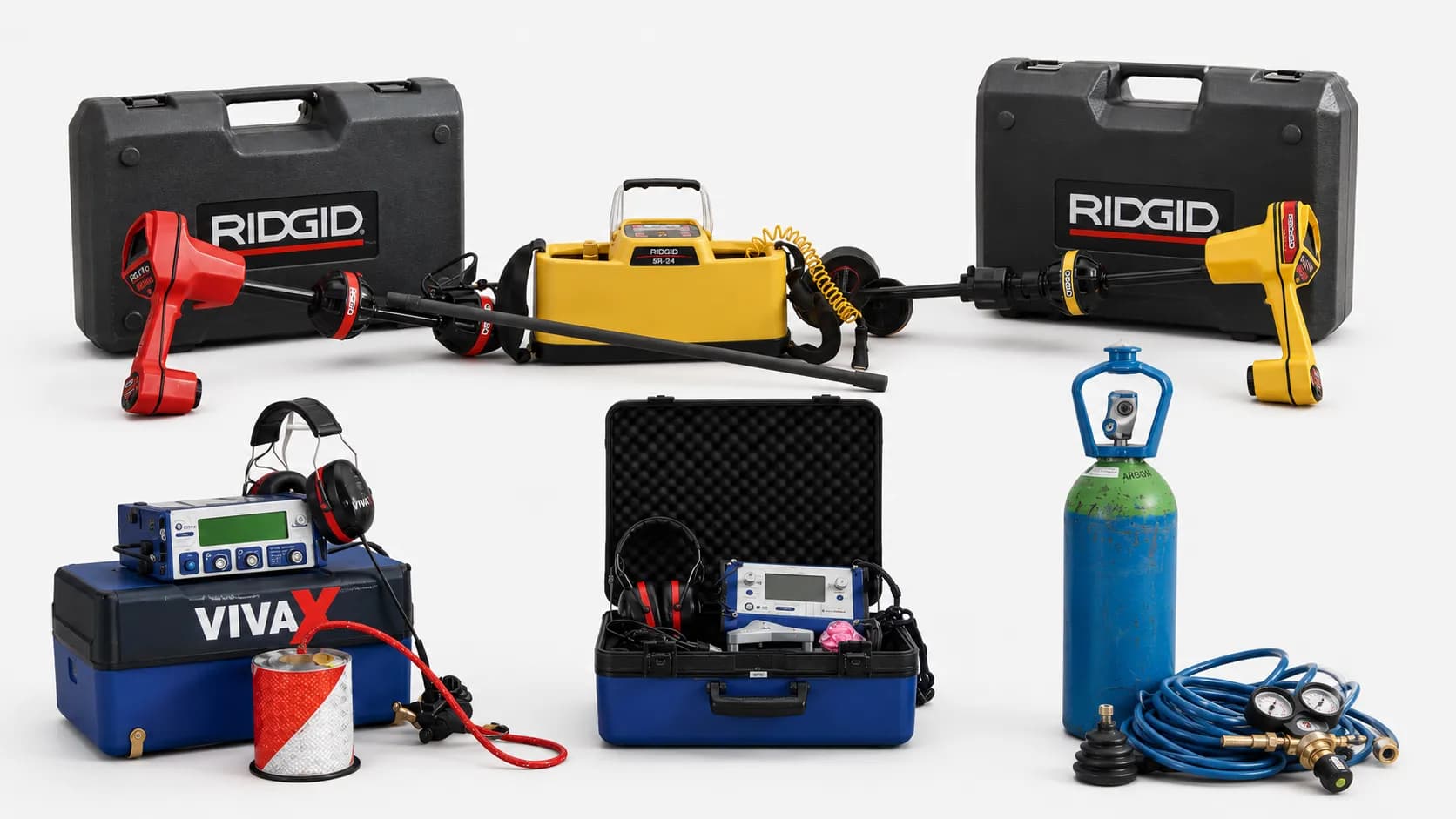
When the leak is in an inaccessible spot for the geophone, the environment is too noisy, the pipework is multilayer plastic that does not transmit sound or pressure is low and intermittent, tracer gas is the decisive technique. We inject an inert nitrogen/hydrogen mixture (95/5) into the line; gas escaping at the leak point is detected at surface level by a highly sensitive catalytic sensor (below 0.5 ppm). It is the same technique used by Italian water utilities to pre-commission new pressurised lines, and is certified for use even in operating residential and industrial environments.
When tracer gas is the right choice
On multilayer plastic pipework that dampens leak noise making the geophone ineffective; in high-background-noise environments such as operating industrial plants, active sites or busy urban areas; on very low-pressure or intermittent leaks where flow doesn't generate constant sound; on gas, compressed air or vacuum piping where noise is essentially absent. It is also the technique used on fire protection networks under load, on pressurised solar thermal circuits and on swimming pool basins to find leak points in concrete, fibreglass or liner structures.
Safety of the technique
The mixture used (95% nitrogen / 5% hydrogen) is inert, non-toxic, non-flammable at the concentrations used (below the lower flammability limit) and disperses completely into atmosphere within minutes. It is the same mixture used by Italian water utilities for pre-commissioning pressurised lines and is approved for use in operating residential environments. Cylinders are ADR-certified and handled only by technicians trained on specific risks.
How the intervention works
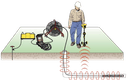
The survey starts with the closure of all delivery points and isolation of the line section to be examined. The cylinder is connected to an available tap or access point and the network is pressurised with the inert mixture. The pipe path is traced at surface level with a handheld catalytic sensor, identifying the gas emission point with centimetric precision. Typical procedure takes 1-3 hours depending on network length and accessibility. At the end, the mixture is vented or allowed to disperse before re-pressurising with water.
Where we operate
Our operative base is in Casale Monferrato (AL). We operate throughout northern Italy — Piedmont (Turin, Alessandria, Asti, Cuneo, Vercelli, Novara), Lombardy (Milan, Bergamo, Brescia), Aosta Valley, Veneto (Venice, Verona, Padua), Liguria (Genoa, Savona, La Spezia), Emilia-Romagna (Bologna, Modena, Parma) — and on request also in France and Switzerland with agreed response times. Our logistics keep a single dedicated technical crew on site from initial survey to intervention completion, avoiding handovers between teams and ensuring continuity throughout the job.
Need an intervention or a quote?
We answer 24/7. Call us or request a free survey.
Frequently asked questions
How accurate is tracer gas?
We localise the leak point within a typical margin of 2-5 cm. It is the most accurate method available for hidden leaks, superior to the geophone on plastic piping and in noisy environments.
Does it work for pools?
Yes — it is one of the most effective methods for finding leaks in pool basins, both on concrete and fibreglass structures, and on supply and return lines. See also our dedicated swimming pool leak detection page.
How much does a tracer gas intervention cost?
Slightly higher than geophone-only detection due to the cost of mixture and specific instruments. Phone quote provided during the initial survey.